
.svg)
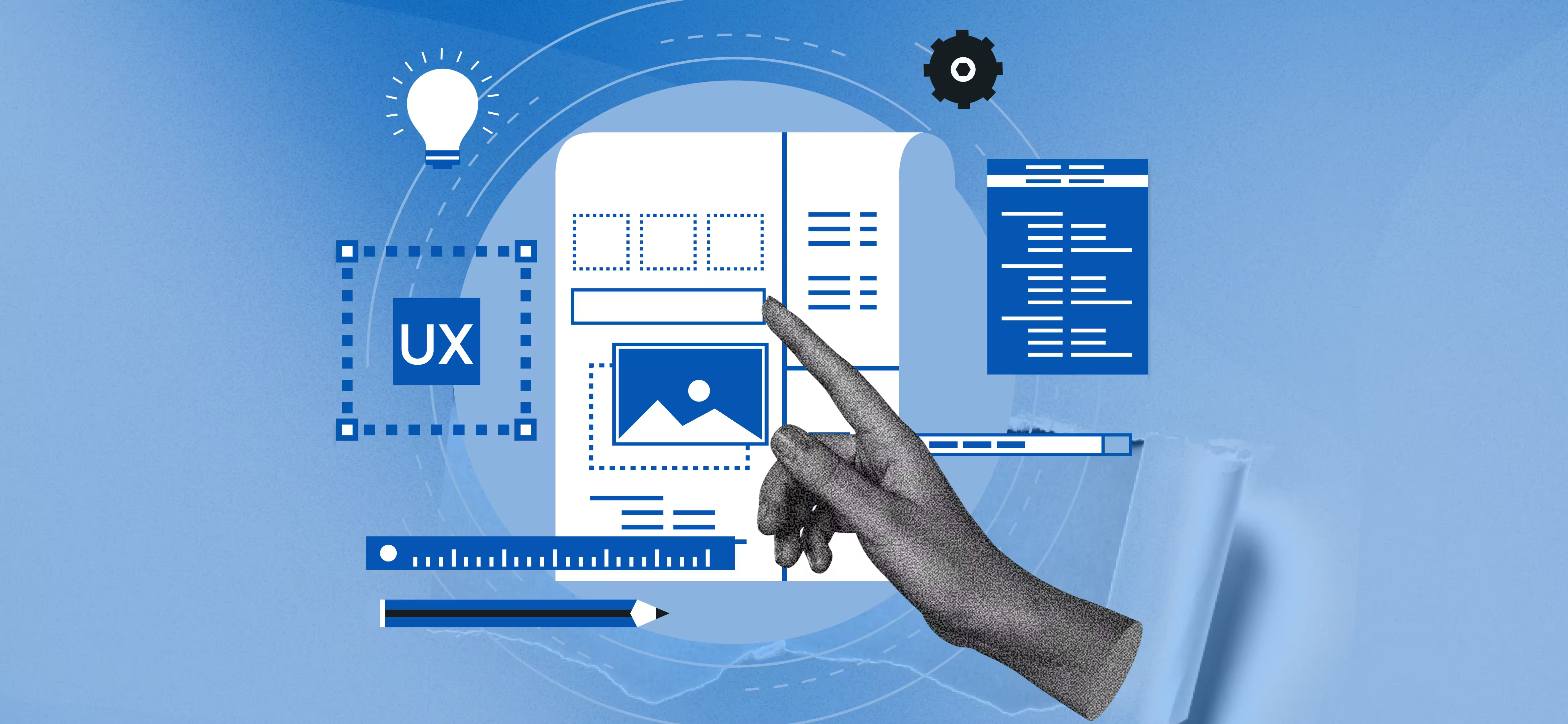


The practice of User Experience (UX) Design has been around since 1990s when the founder of the practice, cognitive psychologist and designer Don Norman, coined the name. Over the past 3 decades, it has become apparent that UX design is a diverse and manifold discipline: challenging and exciting to the novice UX designer. The process is as inherent as the aspect of graphic design and other forms of design, and knowing the various phases can be the key between success and failure.
User Research
The UX design process contains user research. It forms the beginning of a UX design project by all UX designers. Research informs us of who will be using it, how, what, why and what. It also opens to us how they go round our system, where they are experiencing problems and most importantly how they feel when they come in contact with our product.
User research is a mandatory part of becoming a UX designer and, whether you work in a big company, and can afford to pay a team of researchers to conduct it or you are a UXer in a start-up, this is a part of the UX designing process which you cannot afford to neglect. Being the UX designer, you are an expert in your product by definition.
Nevertheless, your perception of intuitivity may not be relevant to your users, and that is why it is so crucial to have real life users do the research that will define what your project will be like in reality.
Wireframing
In UX design, wireframing involves a drawing or a diagram of a page in a web site, software or application that considers:
- Space there was apportioned.
- The dissemination of content and images.
- How content is prioritized
- What are the functions accessible?
- What is the behavior that is meant and accommodated.
Wireframes often do not have any color, images, or styling since their role is to assist the UX team to familiarize and establish the relationship that exists between various templates of a given website. Such templates should be established and then any aesthetic consideration made. Wireframes may be as basic as drawing a sketch on a pencil and a piece of paper which later can be digitized to wireframe into a prototype or more specifications.
Prototyping
A prototype is an outline version of your site or product which brings you as close to an image of your site and interface as you can get before any coding has occurred. This enables the UX designers to test and experiment ideas and also verify functionality and usability before laying down any such money on full-fledged development.
Using the prototype, the purpose of various features is easily understood, and the UX staff can observe the way the overall design will collaborate and correct any flaws or mistakes. The UX team saves quite a number of things, in cost as well as time, by developing a prototype of your design before moving on with the development.
User Testing
Similar to User Research, Testing is an essential element of the UX designer work and a central component of the whole UX design process. The reason why the UX designer tests is because it enables him to make the product or site design better than it was initially and also allow him to check whether or not the changes that he has made during the design stage can withstand scrutiny. It is an excellent method of getting rid of the issues or user inconveniences that were not quite anticipated during the design phase prior to embarking on the implementation phase, as well as being conducted after the product is live as part of a UX audit.
Make sure that you are testing with actual users not with friends or family!
Testing is an art that has been misconstrued and most start-ups and entrepreneurs are intimidated by it due to fears of cost and time. Others fear to make calls to actual users.
Nevertheless, testing cannot be approached without spending a dime at its own risk, and one round of testing can or can be the game changer of your product idea. The time and money that a company invests in the stage of testing will save the infinity of time and money later. As much as you might believe, testing does not necessarily require time or even high costs. And not only that, testing with 5 users has been found to usually reveal 85% of the usability issues.
Usability Testing
Face-to-face usability testing typically a one-to-one moderated usability testing.
The concept is to have participants (preferably, those that fit your target demographic or represent your personas) carry out tasks in your product, site, application, or SAAS as the UX designer or the UX design team watches. The in-person usability testing aims at finding out the problems or the issues that the user has with the interface and the reason behind the problems.
A/B Testing
A/B testing is a form of quantitative comparison of two actual versions of a site, application or e-mail message. It tries to cause targeted changes, which have a statistically significant change in one well-defined user action. It involves one having a good ground on statistics in order to design the test correctly and interpret the results. It also takes experience to select targets of the testing that would most likely yield useful results.
Remember: A/B testing is useful in the case when you already have a product/service but you need to make it better. However, when you are still designing a product, not to A/B tests but user tests.
Wrapping Up:
Using a well-planned UX process, one can also develop products that are not only attractive to the eyes but also user-friendly, functional, and persuasive. Remember, UX design is never truly “finished”. It’s an ongoing cycle of learning, refining, and improving to keep users at the heart of every decision.

Read our latest blogs and resources

Reach Out Anytime Connect with Our Team
.svg)


