
.svg)
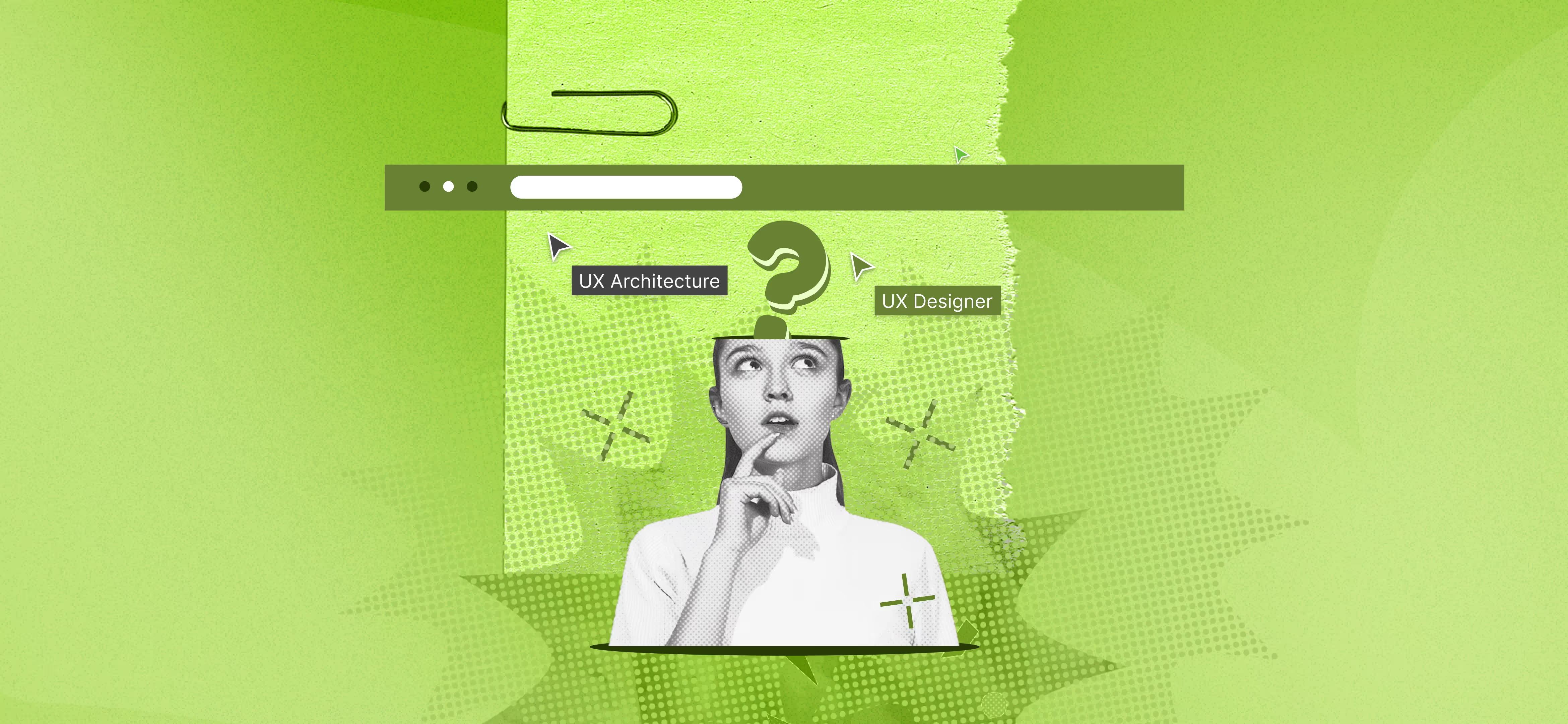


The Role Of A UX Architecture VS UX Designer
To be more precise, today, we are more concerned with user experience than we have ever been. As the concept of UX develops, we find that our responsibilities are increasingly more complex. In detail, UX competencies become more specialized with each passing day.
These days one can hear such positions as a UX designer, UX architect, or even a UX analyst. The two fields operate within the same field but they serve entirely different functions. In this article, we would like to discuss in detail the roles of these roles and how they work together. Let’s dive in!
Who Is A UX Architect?
UX architecture represents a recently developed professional role that blends design expertise with engineering responsibilities. Information architecture created by UX architects, wireframe development, and the technical possibility of the project also come into the UX architect’s responsibility. By their nature, user experience architects, also known as information architects, are centred on the creation of a well-ordered path for products. That is why in a lot of cases they participate in user interviews and user surveys. Once they have assembled all the requirements, they develop prototypes and wireframes for the product. Although they are more focused than designers and do not have such an extensive vision of the user’s path.
What Does a UX Architect Do?
Generally, UX architects make the product serve the needs of the user. They ensure information is well managed and well sorted. There are many more they do. For instance:
Organizing Content
Unlike establishing content strategies to develop and maintain content and assets, a UX architect channels content to fashion an optimal interface for the user. They do:
Web content list—all the digital content about the product.
Content hierarchy—a collection of concepts, a fixed way of constructing the entirety of the product where the dependencies between pieces of information and how they are connected are described.
Content review—a routine check on the product’s content to identify which sections require upgrading, and whether the product requires additional content.
It simply means for a UX architect, one has to understand how the content of each page is laid out and what positions the titles, subheadings, links, and navigation should fit to enable users to find what they are looking for.
Organization, maps, and menu
Information architecture organises a product or website’s taxonomy, site map, and navigation. These elements define the usability of an app or a website we are designing in terms of simplicity and accessibility.
Sitemap – all the sections and standing pages of the app or website.
Focus – how to organise a page based on priority.
Interaction – how a user interacts with an app or a website.
Internal User Interface Design And Low Fidelity Prototyping
These wireframes and low-fidelity prototypes are designed by UX architects to be used by internal UX teams. Thus they can have a plan or an architectural model to work on in designing a certain product or website. These mockups will therefore only be used for design purposes and are typically never employed in referencing and usability tests.
Who Is A UX Analyst?
Research functions as a vital responsibility for analysts within their field. They aim to analyse the users’ needs and whether the clients’ objectives meet the usability objectives. UX analysts determine the features that would enable the product’s customers to achieve their goals by studying the product.
Another thing that analysts are obsessed with is the probability of users completing certain tasks in a given product. They are constantly on the search for factors that could further enhance the utility of a product and thereby enhance customer value.
What Does A UX Analyst Do?
Through their focus on human interaction with technology, UX analysts provide essential insight. They are always in search of ways can make the interactions simpler and effective for your product's success. They also do:
Focused on Customer Satisfaction
UX analysts focus on the user's needs and wants as much as possible. They make sure that your product achieves what users need it for. They provide users with a smooth experience, enhancing their satisfaction and loyalty.
Provide Actionable Recommendations
During the research and analysis, UX analysts obtain important information about the users’ behaviour towards your product. They convert this data into actionable recommendations. It helps as a remedy for user frustrations and generally improves their satisfaction.
Improve Your Product’s Usability
A UX analyst does not leave it at the design level or the first level of design. They pay close attention to user activities and their responses. Then develop your product based on the customers’ changing requirements and that of technology.
Who Is A UX Designer?
In other words, UX design is a rather ambiguous field that includes design and research professions. But in the case of comparing the UX designer with the UX architect, the role of a designer includes designing user interfaces. Lastly, a UX designer brings something to a product that makes it usable.
Lastly, a UX designer will consider wireframes, prototypes and architectural guidelines developed by a UX architect and create a high-fidelity prototype out of them that is closest to the final product than any other design asset. UX researchers together with content designers and UX researchers work hand in hand to identify proper choices for fonts and colors while determining the selection of buttons and all other design elements.
What Does A UX Designer Do?
User experience (UX) designers usually design products and services that meet users’ requirements and offer meaningful value to these users. They do branding, design, and many more. Such as:
Persona Development
UX designers are involved in the initial analysis of the task and the development of user-profiles. Large organizations may employ a professional UX researcher or a team of UX researchers but they perform a UX design function. User personas inform UX designers about the demographics of the user. It can be his or her wants, possibilities of response, and much more to ensure the user interfaces are designed to suit the users.
Wireframes, Mockups And Prototypes
Wireframes, mockups and prototypes are slightly different from each other but have many similarities to each other.
A UX designer makes the product’s pages and flows through the wireframes and mockups based on the initial research and information architecture by the UX architect.
This is also referred to by UX designers because they have to use the sitemap of the UX architect to link the pages and the navigation. It helps them to work on low-fidelity and high-fidelity prototypes. These high-fidelity prototypes will be employed in usability studies as research teams attempt to understand how the final product will be used.
User Testing
Whenever the specific organization does not conduct its research, the UX designers have to complete the usability tests on their own. This critical stage of UX design gives UX designers important feedback on how customers are going to engage with the final output. UX designers adjust their designs based on the data obtained from usability testing to fine-tune the interface.
What Is The Difference Between A UX Designer And A UX Architect?
The main difference lies in the fact that a UX architect has a wider perspective, while a UX designer is more involved with the work on specifics. The UX architect is more concerned with the flow and pathways that users follow while the UX designer ensures the look and feel of every screen or page. As much as the UX architect and the UX designers have a look at the research, the UX architect will be wondering what features and content the user shall be interested in. On the other hand, the UX designer wants to know the way the user is going to engage in these aspects.
How UX Architects, UX Analysts & UX Designers Work Together
As already mentioned, small businesses are many that employ a UX designer to perform the role of a UX architect. When roles get split into two distinct specializations the resulting professional is called a UI designer (user interface designer) since they exclusively focus on interface development.
The UX architect is a UX expert in information architecture and not in design.
Content is one of the closest working fields of UX architects and UX designers. While the UX designer works on the details of the content, the UX architect determines how that content should be organized. Getting this right is not easy but this involves a close collaboration between designers/architects.
This presentation outlines the typical working sequence between UX architects and UX designers in their team engagement process:
- The project begins its lifecycle when a UX architect conducts work based on market and user analysis. They will discover what a project requires and how best to organize the content. Then they will be getting right down to the drawing board like a construction architect.
- The UX architect creates a plan (wireframes and prototypes) for the UX designer to follow while building. Using wireframe, mock-up, and high-fidelity prototype, the UX designer will present the design to stakeholders and conduct a usability test.
- While in the usability tests – the UX architect cares to know how the user gets to the content and moves within the product. The UX designer needs insight into how users interact with screen-contained elements and content.
- The UX architect becomes responsible for maintaining correct and up-to-date content after a product launches into the market. They will also discuss the accessibility concerns or lack of them and suggest improvements. The UX designer will then consider the recommendations made by the UX architect and study the interaction data. It will help him/her improve every screen by making it most suitable for the user.
Does Your Company Need A UX Architect & A UX Designer?
As each team is responsible for different design aspects, it is also beneficial to split the work of a UX/UI designer and a UX architect of a product or a website for a better result. Startups and smaller projects may not offer enough work for a dedicated UX architect to do. However, it should be pointed out that UX designers can provide the key functions of a UX architect.
Projects which grow in size make UX designers hard to control and need extensive time commitments. In such a case, a UX architect is an essential member of any team carrying out such a project.
Usually, agencies are in small teams, and they have more than one app and website per client. This way, they can have a UX architect who provides all the required data and all the information to start building a product for the UX designers. Thus develop a tech production line.
If you can’t take decisions you can go through the below questions:
- What percentage of time is spent on the creation of layouts and architecture by UX designers?
- Do such tasks cause production delays?
- Are navigation problems frequently identified during usability testing?
- How much does it cost to have a dedicated UX architect in contrast to potential gains from high quality and productivity?
- Is your product’s usability and accessibility regularly a problem?
- Is there someone who is supervising the content of your product? Have you ever discovered information on your website that is no longer up-to-date or product features that are not currently being used?
Bottom Line:
It must be noted that both of these roles differ and cannot be substituted with one another. The designers fulfil the essential role of direct development for the usable components of a product as opposed to UX architects and analysts. In a nutshell, they are the ones who make decisions on who stands where in the structure of the organization. I hope this information assists with your selection process if you need to employ someone.

Read our latest blogs and resources


Reach Out Anytime Connect with Our Team
.svg)


